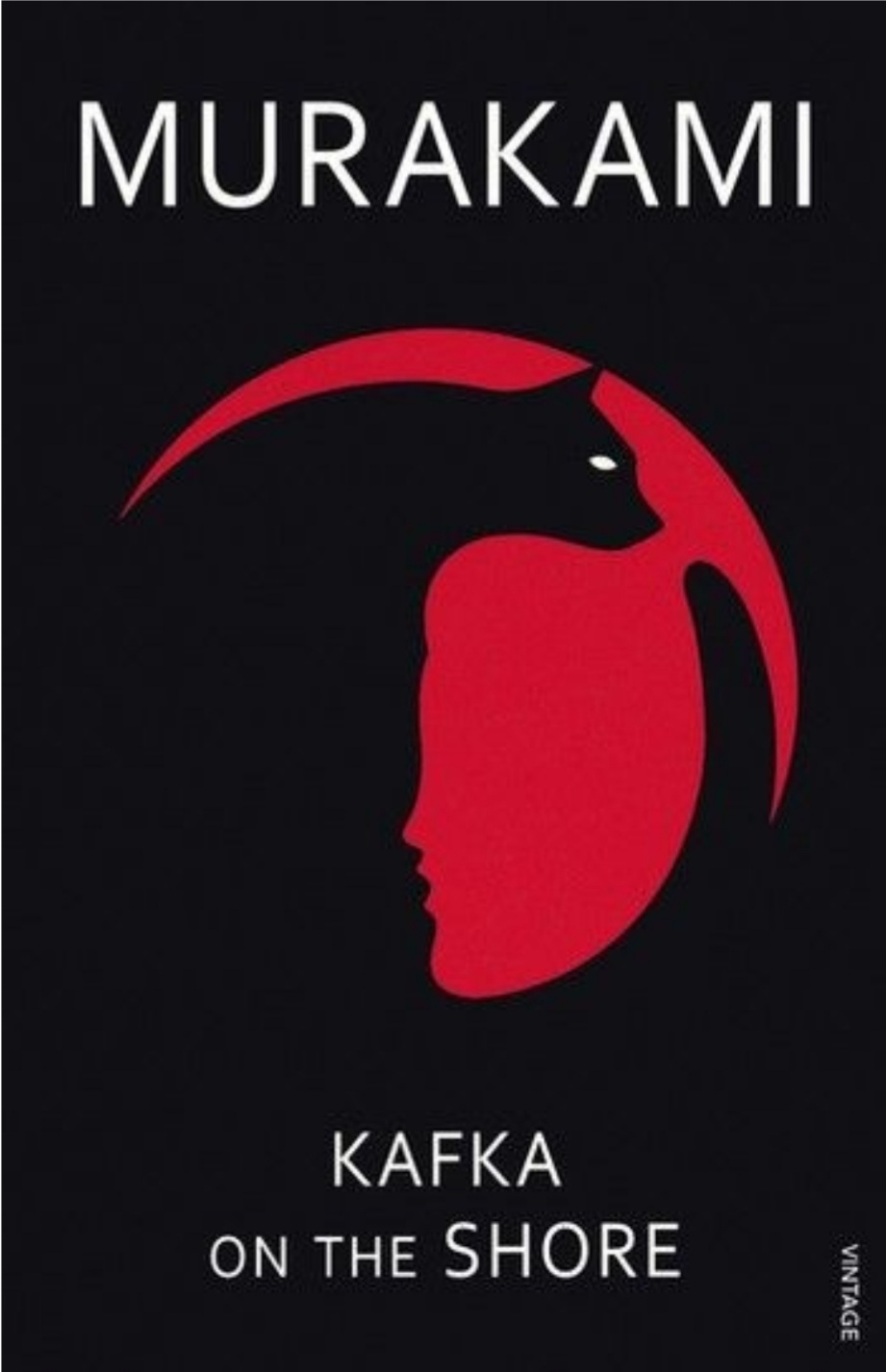
Kafka on the shore is powered by two remarkable characters: a teenage boy, Kafka Tamura, who runs away from home either to escape a gruesome oedipal prophecy or to search for his long-missing mother and sister; and an aging simpleton called Nakata, who never recovered from a wartime affliction and now is drawn toward Kafka for reasons that, like the most basic activities of daily life, he cannot fathom. Their odyssey, as mysterious to them as it is to us, is enriched throughout by vivid accomplices and mesmerizing events. Cats and people carry on conversations, a ghostlike pimp employs a Hegel-quoting prostitute, a forest harbors soldiers apparently unaged since World War II, and rainstorms of fish (and worse) fall from the sky. There is a brutal murder, with the identity of both victim and perpetrator a riddle—yet this, along with everything else, is eventually answered, just as the entwined destinies of Kafka and Nakata are gradually revealed, with one escaping his fate entirely and the other given a fresh start on his own.
Kafka on the Shore interweaves between two parallel plots to tell the story of Kafka Tamura — a 15-year-old boy who runs away from home to escape an Oedipal curse and Nakata — an elderly Japanese man who has an uncanny ability to speak to cats due to a childhood accident and who spends his days locating and returning lost cats to their owners. Although the two characters seem to be on their own journeys, their paths inevitably intertwine towards the end of the novel for an intriguing and hyper-surrealist ending.
Kafka’s journey represents both the freedom of escapism and the overwhelming sense of sadness from his solitude, he is no ordinary 15-year-old boy and his experiences are punctured by the discovery of love, loss, longing, and uncertainty of himself.
Conversely, Nakata is an elderly man in the twilight years of his life who seemingly lived a life without purpose or self-determination. Due to his inability to read or write, he is shunned by his family and society but his special ability to talk to cats leads him on an adventure involving murder, unusual things falling from the sky, and obtaining a stone to open the pathway to an alternate reality.
“Happiness is an allegory, unhappiness a story.”
Whether you have a Murakami collection at home or are a newbie to his works, Kafka on the Shore is a fantastic starting point to dive into his mastermind.
This is undoubtedly a page-turner and metaphysical mind-f*ck to sink your teeth into — beautiful, haunting, and with no real solutions to the many riddles scattered in the novel. As Murakami states in an interview, the secret to understanding Kafka on the Shore is to read it several times and I have no doubt I will be re-reading this sometime in the future.
Personally HARUKI MURAKAMI is my favorite author. You will definitely love ❤his writing.
 DuckDesk