What is special relativity?
The theory is based on two key concepts.
- First, the natural world allows no “privileged” frames of reference. As long as an object is moving in a straight line at a constant speed (that is, with no acceleration), the laws of physics are the same for everyone. It’s a bit like when you look out a train window and see an adjacent train appear to move — but is it moving, or are you? It can be hard to tell. Einstein recognized that if the motion is perfectly uniform, it’s literally impossible to tell — and identified this as a central principle of physics.
- Second, light travels at an unvarying speed of 186,000 miles a second. No matter how fast an observer is moving or how fast a light-emitting object is moving, a measurement of the speed of light always yields the same result.
Starting from these two postulates, Einstein showed that space and time are intertwined in ways that scientists had never previously realized. Through a series of thought experiments, Einstein demonstrated that the consequences of special relativity are often counterintuitive — even startling.

“A page of the original manuscripts of the theory of relativity developed by Albert Einstein on display at the Israeli National Academy of Science and Humanities in Jerusalem on March 7, 2010”
If you’re zooming along in a rocket and pass a friend in an identical but slower-moving rocket, for example, you’ll see that your friend’s watch is ticking along more slowly than yours (physicists call this “time dilation”).
What’s more, your friend’s rocket will appear shorter than your own. If your rocket speeds up, your mass and that of the rocket will increase. The faster you go, the heavier things become and the more your rocket will resist your efforts to make it go faster. Einstein showed that nothing that has a mass can ever reach the speed of light.
Another consequence of special relativity is that matter and energy are interchangeable via the famous equation E = mc² (in which E stands for energy, m for mass, and c² the speed of light multiplied by itself). Because the speed of light is such a big number, even a tiny amount of mass is equivalent to — and can be converted into — a very large amount of energy. That’s why atomic and hydrogen bombs are so powerful.
What is general relativity?
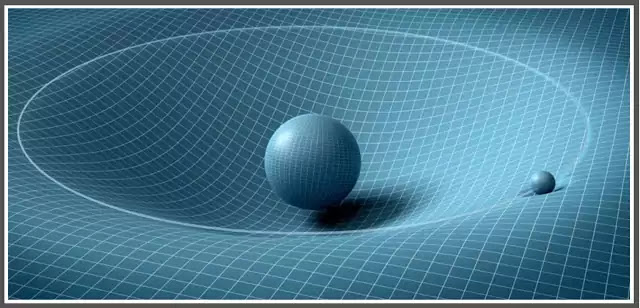
Essentially, it’s a theory of gravity. The basic idea is that instead of being an invisible force that attracts objects to one another, gravity is a curving or warping of space. The more massive an object, the more it warps the space around it.
 DuckDesk